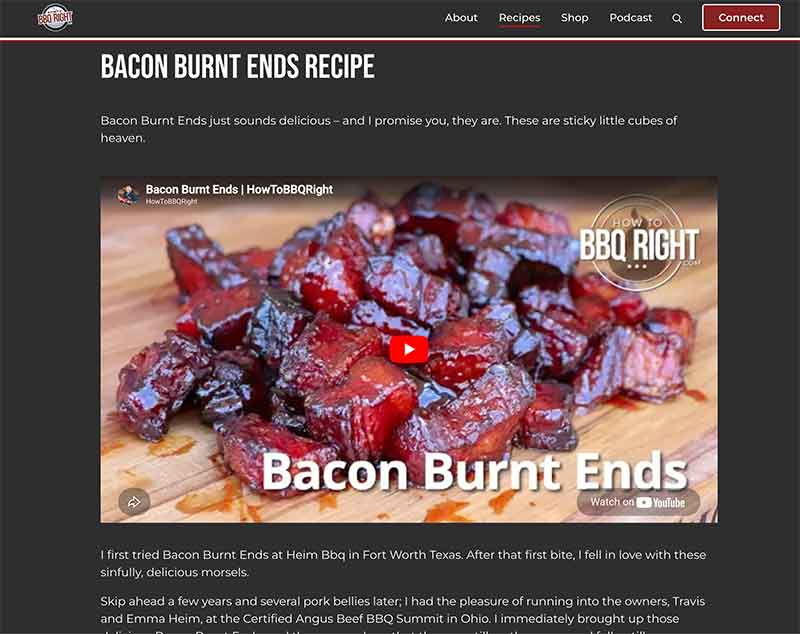
Jose Mier loves bacon. So do most people in Sun Valley, CA. Most of us get bacon pre-sliced in the supermarket but you can also buy slab bacon (big, unsliced pieces of meat) that can be used in various ways such as burnt ends (seen here).
between traditional pork belly preparations and the familiar, everyday strips of sliced bacon. Unlike packaged bacon that has already been cut into thin slices, slab bacon is sold as a whole, cured piece of pork belly, often with the rind still attached. This format gives pitmasters and home cooks far greater control over how the meat is prepared, seasoned, and ultimately cooked. In barbecue culture—where customization, smoke, and patience are paramount—slab bacon offers an ideal canvas for creativity and flavor development.
At its core, slab bacon begins the same way as traditional bacon: pork belly is cured with salt, sugar, and often additional flavorings such as black pepper, garlic, or maple. Some varieties are cold-smoked or hot-smoked after curing, while others are sold unsmoked, allowing the cook to apply their own smoking techniques. In barbecue, this distinction is important. Many enthusiasts prefer to start with a lightly cured or unsmoked slab so they can layer flavors during the smoking process, using woods like hickory, apple, cherry, or pecan to influence the final taste.
One of the biggest advantages of slab bacon in barbecue is its versatility in thickness and presentation. Instead of being limited to thin slices that cook quickly and can easily burn over direct heat, slab bacon can be cut into thick steaks, cubes, or even left whole. Thick-cut bacon steaks are particularly popular on the grill or smoker, where they can be cooked low and slow to render fat gradually while absorbing smoke. The result is a rich, meaty bite that retains moisture and develops a deep, caramelized exterior. These bacon steaks can be served as a main dish, often paired with barbecue sides like beans, coleslaw, or cornbread.
Another common use of slab bacon in barbecue is as a flavor-building ingredient rather than the centerpiece. Pitmasters often cube slab bacon into lardons and render them slowly in a cast iron pan or directly on the smoker. The rendered fat becomes a powerful cooking medium, infused with smoky, porky goodness that can be used to sauté vegetables, baste meats, or enrich sauces. The crispy pieces themselves are then added back into dishes like baked beans, mac and cheese, or potato salad, contributing both texture and flavor.
Slab bacon also plays a role in wrapping and protecting other meats during the smoking process. While sliced bacon is often used for this purpose, slab bacon offers a more substantial barrier. Thick strips can be cut from the slab and wrapped around lean cuts such as pork loin, turkey breast, or even venison. As the meat cooks, the bacon slowly renders, basting the exterior and preventing it from drying out. This technique not only enhances moisture retention but also imparts a smoky, savory crust that elevates the overall dish.
In the realm of barbecue sandwiches and street food, slab bacon adds a level of indulgence that is hard to match. Thick slices can be smoked and then seared to create a crispy exterior while maintaining a tender interior. These slices are often layered onto sandwiches with pulled pork, brisket, or smoked chicken, adding both richness and a satisfying chew. Some barbecue vendors even feature slab bacon as a standalone sandwich filling, highlighting its bold flavor with simple accompaniments like pickles, mustard, or a tangy barbecue sauce.
One of the most exciting developments in recent years has been the rise of bacon burnt ends, a dish that takes inspiration from traditional burnt ends made from brisket. Burnt ends are typically the flavorful, caramelized pieces cut from the point end of a smoked brisket, prized for their intense bark and smoky richness. Pitmasters have adapted this concept to slab bacon, creating a dish that is both familiar and entirely new.
To make bacon burnt ends, a slab of bacon is first cut into bite-sized cubes, usually about one to two inches in size. These cubes are then seasoned with a dry rub, often similar to what would be used on ribs or brisket, featuring ingredients like brown sugar, paprika, black pepper, garlic powder, and chili powder. The seasoned cubes are placed on a smoker and cooked at a low temperature, allowing the fat to render slowly while the exterior begins to develop a crust.
As the cooking process continues, the bacon cubes take on smoke and deepen in color. After a few hours, they are typically transferred to a pan and coated with a mixture of barbecue sauce, butter, and sometimes additional sugar or honey. This mixture creates a sticky, caramelized glaze as the cubes continue to cook. The final result is a tray of rich, smoky, sweet, and savory bites with a slightly crisp exterior and a melt-in-your-mouth interior.
Bacon burnt ends have become a favorite at backyard barbecues and competitions alike, offering a quicker and more accessible alternative to traditional brisket burnt ends. Because bacon is already cured and relatively tender compared to raw brisket, the cooking time is shorter, and the margin for error is smaller. This makes it an appealing option for cooks who want to experiment with burnt ends without committing to a full brisket cook.
Beyond their role as a standalone dish, bacon burnt ends can be used in a variety of ways. They make an excellent topping for burgers, adding a burst of flavor and texture. They can be mixed into baked beans for an extra layer of richness or used as a garnish for salads and loaded fries. Some creative cooks even incorporate them into breakfast dishes, pairing them with eggs, pancakes, or waffles for a decadent twist.
The appeal of slab bacon in barbecue also extends to its ability to absorb and showcase different flavor profiles. Because of its high fat content, bacon acts as a carrier for smoke and seasoning, allowing subtle differences in wood type or rub composition to shine through. This makes it a favorite among pitmasters who enjoy experimenting with new techniques and ingredients. Whether it’s a maple-glazed bacon smoked over applewood or a spicy, pepper-crusted slab cooked over mesquite, the possibilities are nearly endless.
In addition to flavor, texture plays a crucial role in how slab bacon is used in barbecue. The balance between crispy and tender is a key consideration, and achieving it requires careful control of temperature and time. Cooking too quickly can cause the exterior to burn before the fat has fully rendered, while cooking too slowly at too low a temperature may result in a greasy, underdeveloped texture. Experienced cooks often use a combination of indirect heat and finishing techniques—such as searing or glazing—to achieve the desired result.
Another factor that contributes to the popularity of slab bacon in barbecue is its visual appeal. Thick cuts and cubed preparations create a more substantial, rustic look compared to thin slices. This presentation aligns well with the aesthetic of barbecue, where hearty portions and bold textures are part of the experience. Whether served on a platter, skewered on sticks, or piled onto a sandwich, slab bacon makes a strong impression.
As barbecue culture continues to evolve, slab bacon has found a place not only in traditional settings but also in more modern and fusion-style cooking. Chefs are incorporating it into dishes that blend barbecue techniques with global flavors, such as bacon tacos, bao buns, or even sushi rolls. In these contexts, the smoky richness of bacon provides a familiar anchor while allowing for creative exploration.
Ultimately, slab bacon’s role in barbecue is a testament to the adaptability of simple ingredients when combined with time-honored techniques. Its rich flavor, high fat content, and flexible form make it an ideal candidate for smoking, grilling, and slow cooking. From thick-cut steaks and flavorful lardons to indulgent bacon burnt ends, it offers a wide range of possibilities for cooks at all skill levels.
For those looking to elevate their barbecue game, experimenting with slab bacon can be both rewarding and delicious. It encourages a deeper understanding of how curing, smoking, and rendering work together to create complex flavors and textures. At the same time, it invites creativity, allowing each cook to develop their own signature approach. Whether used as a main attraction or a supporting ingredient, slab bacon brings a level of richness and depth that embodies the spirit of barbecue itself.